Rank Competition and Guided Missions as a Continuous Growth Loop
Building a progression system that guides streamers from competition entry to goal-driven growth execution.
I transformed fragmented growth mechanics into a connected engine: rank progression, stage-based missions, and reward reinforcement loops.
A Two-Layer Growth System for Continuous Streamer Progression
This project built a streamer growth engine on a live platform where supply stability and retention are strongly tied to streamer motivation.
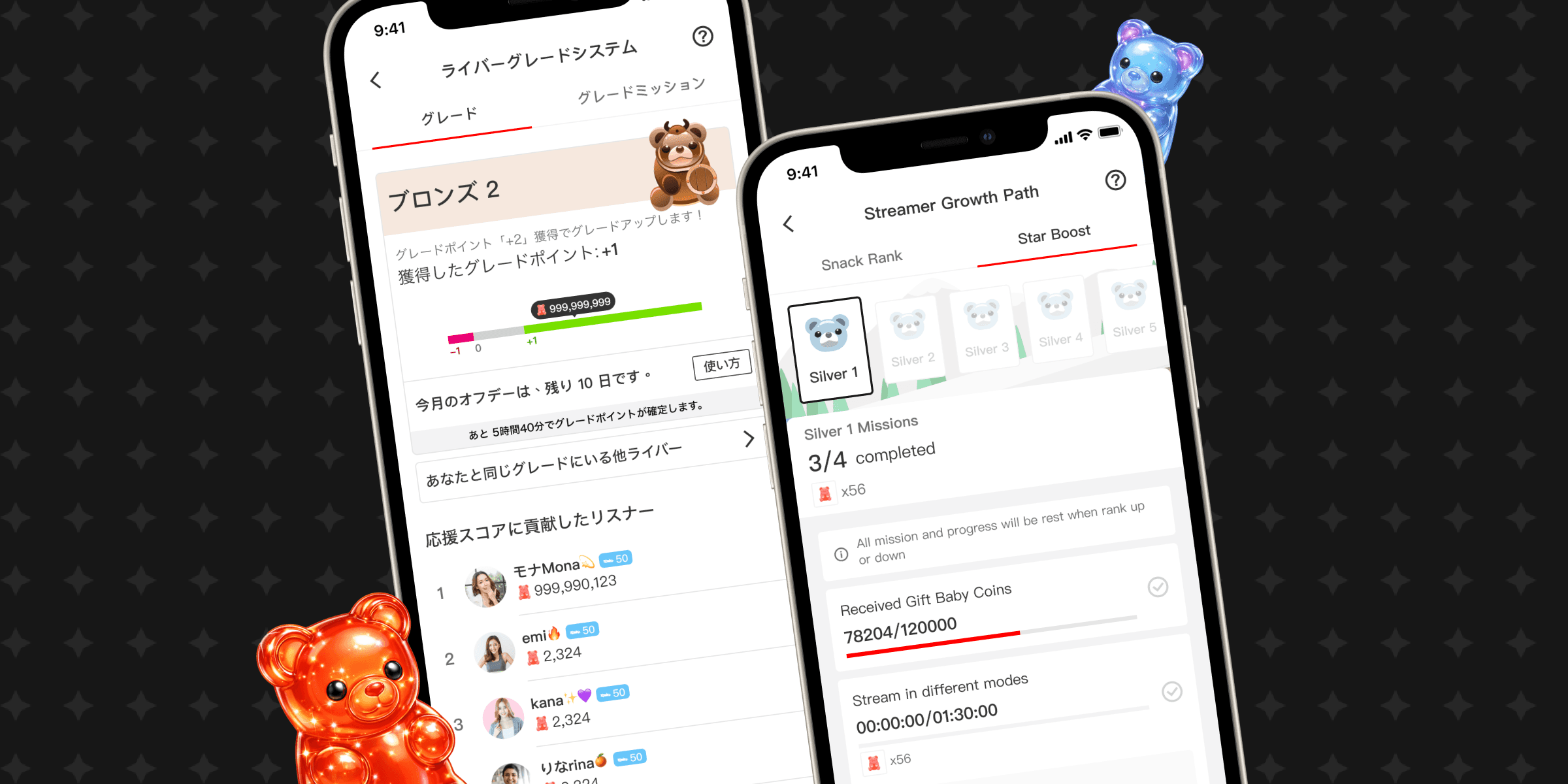
The first phase was Snack Rank, which established a visible progression framework and competitive movement through rank-up and rank-down mechanics.
The second phase was Star Boost, a mission-and-reward layer mounted on top of Snack Rank to help streamers who did not know how to plan their own growth path.
Together, these two systems turned ranking from a passive status display into an active, guided growth loop.
The Limits of the Previous Incentive Model
The platform needed streamers to keep broadcasting consistently while improving content quality and audience value over time.
Before this work, the incentive model mainly relied on repeating monthly task cycles. Streamers could complete tasks individually, but the system did not create an ongoing competitive structure that encouraged healthy comparison and collective growth across the broader streamer group.
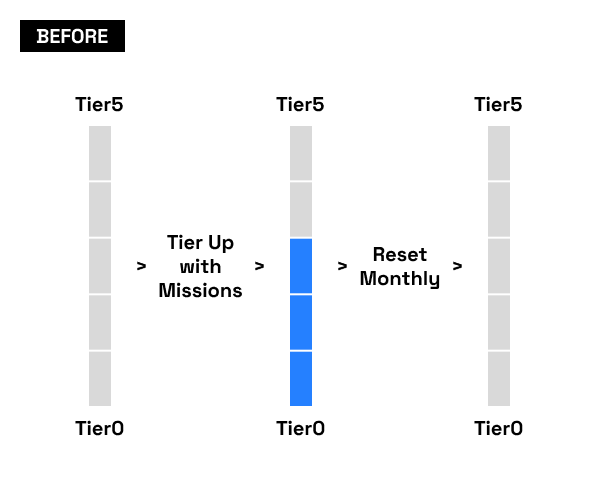
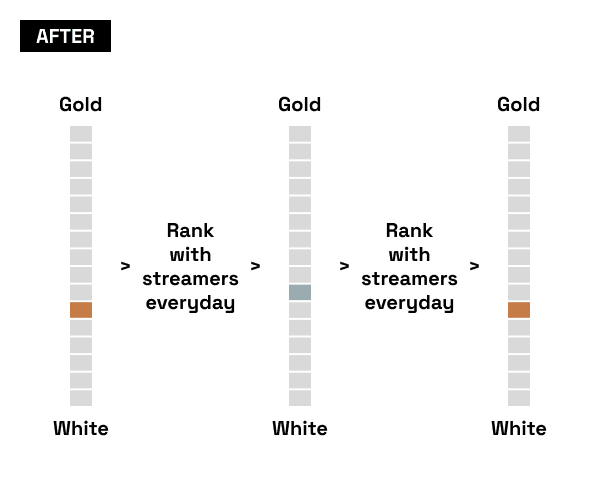
Competitive pressure mostly appeared only during campaign periods, rather than as part of the platform's everyday growth model. As a result, streamers had limited visibility into whether they were continuously improving relative to their wider peer group.
Through VOC, we observed that many streamers also did not have a concrete strategy for growth planning. This created a gap between motivation, positioning, and execution.
We delivered a two-layer growth system:
This created four new capabilities:
I was the product designer across the progression-system work, from Snack Rank through Rest Day and the later Star Boost extension.
Two-Way Rank Movement
I designed rank progression with both upward and downward movement instead of one-way advancement.
One-way progression creates passive accumulation; without demotion risk, competition loses its ongoing behavioral signal.
An always-on competitive signal — because rank could fall as well as rise, streamers had a reason to maintain activity continuously rather than coasting after hitting a milestone.


Rest Day for Sustainable Participation
I introduced a “Rest Day” mechanism to pause accumulation pressure without resetting rank standing.
Without pacing relief, high-pressure systems increase burnout risk and reduce long-run participation for streamers with irregular schedules.
A sustainable participation model — pressure paused, but standing preserved — making the rank system usable for a wider streamer profile.
Stage-Based Mission Guidance
I built Star Boost as a rank-mounted mission system after VOC revealed that most streamers didn't know how to plan their own growth.
Competition alone did not tell streamers what to do next; they needed explicit directional guidance at each stage.
A progression experience where guidance evolved with the streamer — entry-tier missions focused on activity fundamentals, mid-tier missions shifted toward monetization goals, and the mission set itself became a stage signal.
Two-Point Reward Structure
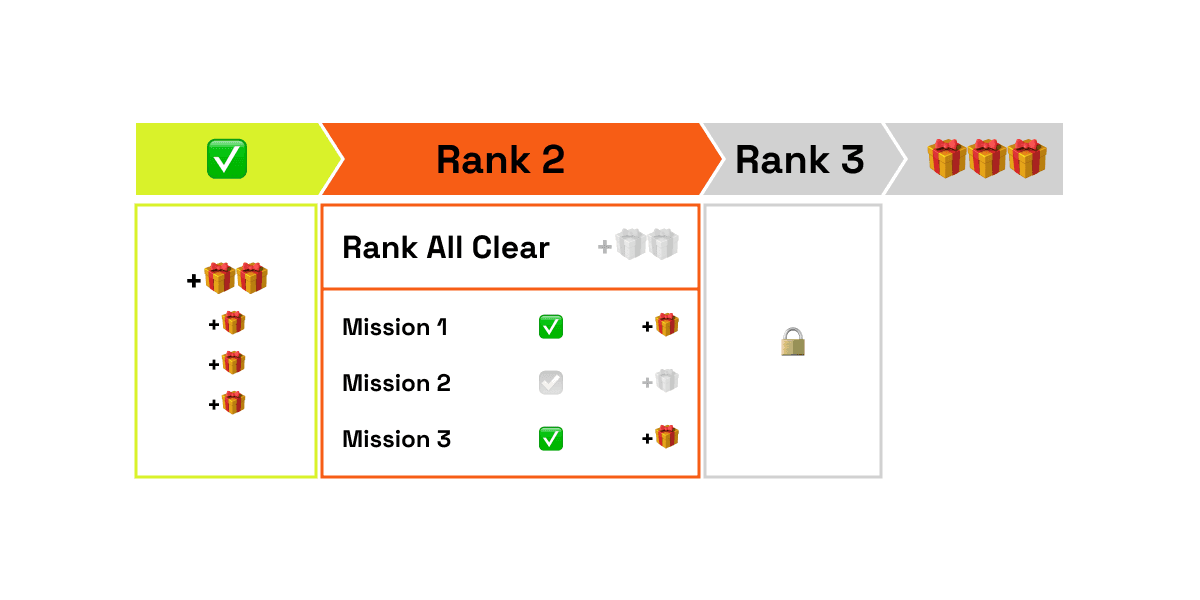
I tied rewards to both individual mission completion and full rank-group completion.
Single-point rewards drive short bursts; layered checkpoints sustain continuity and progression depth.
Two separate reinforcement points kept early-tier mission completion around 40%+ — the shorter feedback loop gave enough immediate signal to maintain engagement before streamers felt the longer-term rank impact.
Rank Progression (Snack Rank)


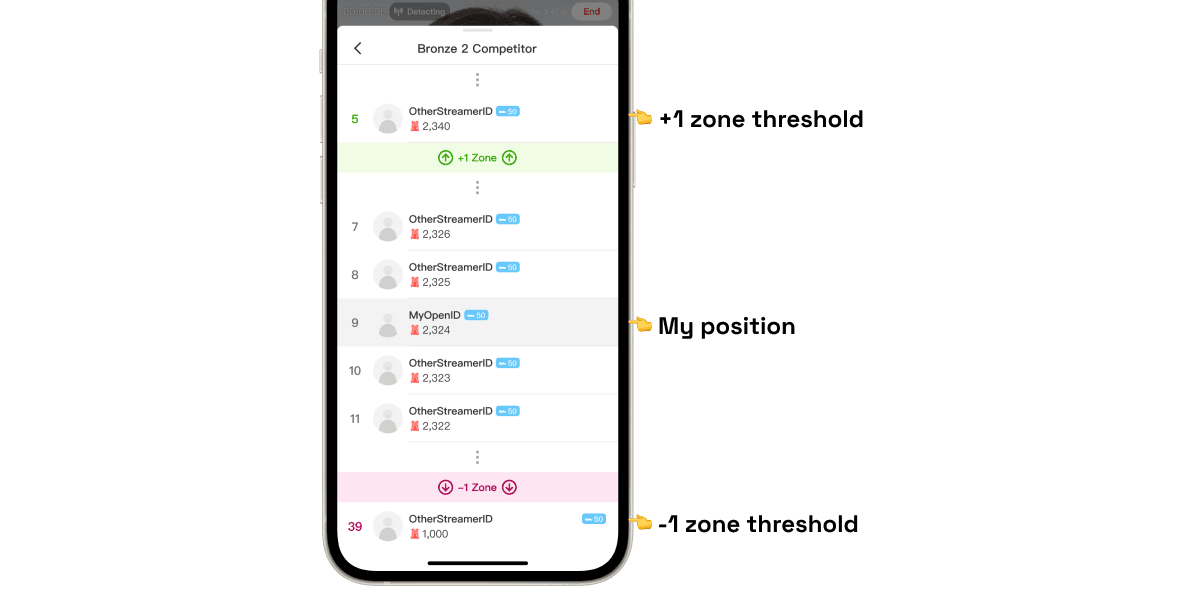
I started from rank progression, because the whole system would stay passive if streamers could not immediately tell whether they were moving up, staying flat, or drifting toward demotion. So I designed the ladder and progression states to make status change legible at a glance. Promotion and demotion communication also had to feel fair. If it felt punitive or opaque, the system would lose trust fast. That is why I always showed current position and next-step targets together. Showing status alone would have created awareness without action.
Pressure Management (“Rest Day”)
Rest Day came from a different kind of problem. Once the system started putting real pressure on streamers, I needed a way to reduce that pressure without collapsing the logic of competition. The ticket system therefore had three clear behaviors: if a streamer had remaining tickets and did not go live, protection applied automatically; if they started broadcasting that day, the ticket was reclaimed; and if they performed poorly and wanted to pass, they could actively use a ticket so that day's result would not be counted.
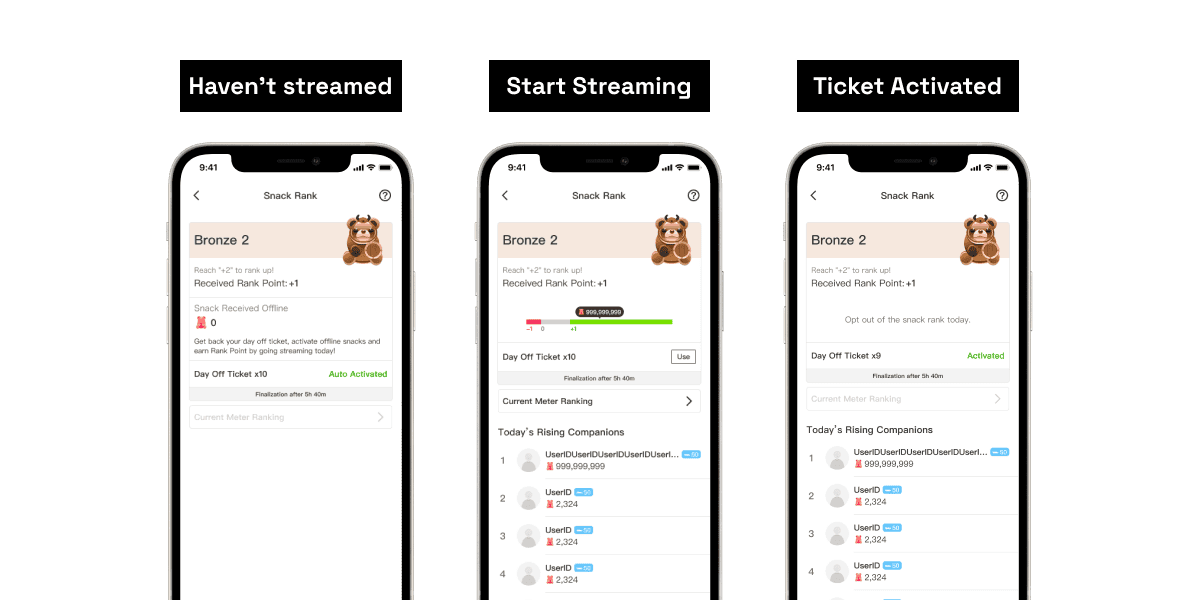
That made rule communication and entry points central to the design. Streamers needed to know exactly what was auto-protected, what was cancelled by going live, and what required an intentional choice. Without that clarity, the feature would have created more anxiety than relief.
Mission Guidance (Star Boost)
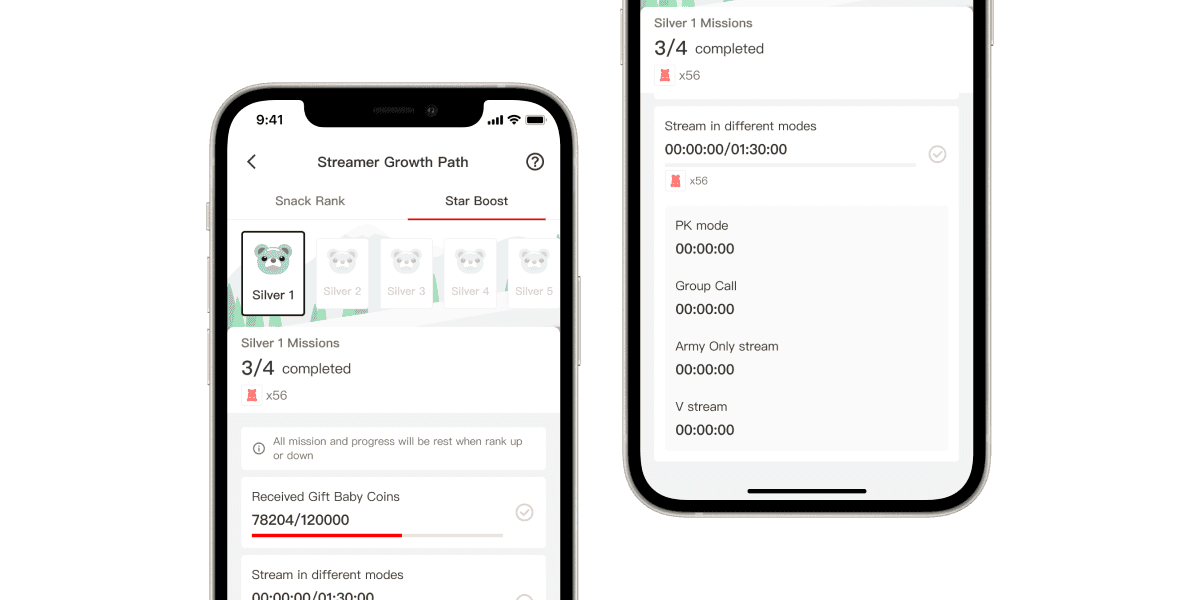
Star Boost was where I translated competition into guidance. I designed the mission architecture by rank level and by gradients within each level, because one flat mission set would have been noise for advanced streamers and overwhelming for early-stage ones. I mapped missions to stage goals such as accumulated comments, follower growth, broadcast duration sprints, paid subscription growth, and live-clip highlights publishing. The point was to make the mission set itself feel like stage guidance, not just more tasks.
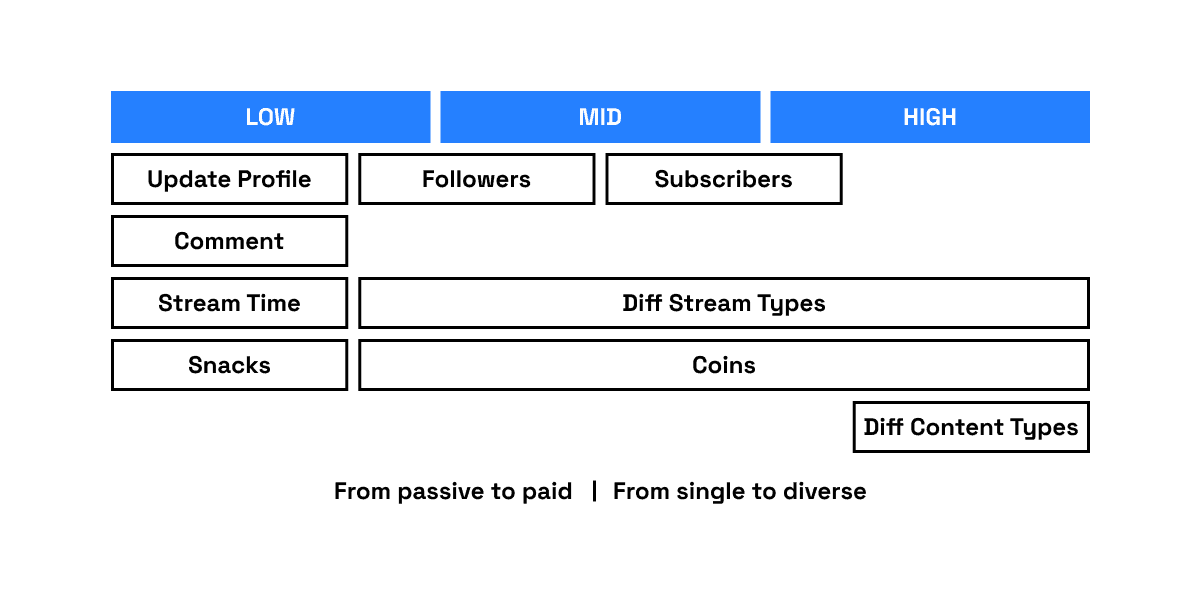
Then I built the feedback layer around it: mission status, completion signals, and reward triggers, so streamers could see how close they were to the next payoff instead of guessing. I also defined the module so the same mission logic and UI patterns could be reused later without rebuilding from scratch. The system only started to feel complete when rank progression, pacing relief, and mission guidance read as one connected loop instead of three separate mechanics. That was the point where the design stopped feeling like a set of features and started behaving like one incentive system.
What This Indicates
Rank visibility alone was not enough; pairing competition with guided missions created a more reliable activity and progression loop.
The strongest gains appeared in early-to-mid tiers, showing that explicit goals and stage-based incentives were especially effective for streamers who lacked a clear growth plan.
What worked well
The strongest bet was changing progression from individual accumulation into an always-on competitive system among streamers at the same level. That shift turned growth from a private, repetitive task cycle into a visible behavioral loop, and Star Boost later worked because it was mounted on top of that stronger competitive foundation rather than replacing it.
What was challenging
The system needed long-term consistency to work, but operational strategy and budget varied by region. Some regions adopted the new incentive model while others continued using the old one, which made the growth framework harder to roll out as a shared platform rule and reduced how fairly outcomes could be compared across markets.
What to improve next
I would leave more design room for pacing and pressure-relief mechanisms earlier in the system. “Rest Day” only became obvious after strong streamers reacted to the live pressure of the model, which showed that sustainability features may not fully surface until a competitive system meets real usage at scale.